
Two hits and your friend is gone. Meanwhile, you’re five deep, wondering if the weed is even working. If this feels familiar, you’re not alone.
People talk about strain, potency, even rolling technique — but almost no one explains why cannabis affects everyone differently on a biological level. And that’s where the real clarity lives.
This is where the science of weed tolerance finally makes sense. Some people naturally use less. Some people need more. Some people feel nothing the first few times. And some swear their tolerance shoots up overnight.
The truth? Weed tolerance isn’t random. It’s shaped by your genetics, your brain chemistry, your metabolism, your habits, and the way your endocannabinoid system adapts to THC over time.
Let’s break it down.
What Is Weed Tolerance?
At its core, weed tolerance describes what happens when your brain becomes less responsive to THC — the psychoactive compound that creates the familiar high.
More professionally, you’ll see it described as cannabis tolerance, marijuana tolerance, or even THC tolerance depending on the context.
How THC Works
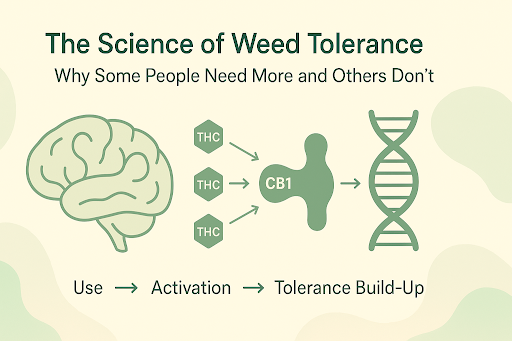
THC binds to CB1 receptors in the brain. When those receptors activate, you feel high.
But with repeated exposure, the brain adapts:
- It reduces the number of available receptors
- It makes those receptors less sensitive
- It adjusts its own internal cannabinoid signaling
This is called pharmacodynamic tolerance — changes in the brain’s response to THC.
There’s also metabolic tolerance, when your liver simply gets better at breaking down THC before it even reaches your brain.
Metabolic Tolerance
Metabolic tolerance happens when your body clears THC more quickly than average, often due to natural genetic differences in liver enzymes like CYP2C9. If you metabolize THC fast, it doesn’t stay in your bloodstream as long or reach the same intensity, which means the effects feel noticeably weaker—even when your dose hasn’t changed. Over time, this can make cannabis feel less potent because your system is simply processing it at high speed.
Behavioral Tolerance
Over time, your brain learns the “pattern” of being high, so the experience feels less intense. Environment and routine also play a role.
This is why smoking the same strain in the same spot feels different from smoking in a new environment.
Genetics: Why Tolerance Varies So Much Between People
If how weed tolerance works is based on frequency, what explains those who are seemingly immune to THC from the start? The answer is your DNA.
This is where genetic factors affecting cannabis tolerance come into play, providing the blueprint for your natural sensitivity—or lack thereof—to the cannabis plant.
The Key Genetic Players
Specific genetic variations influence how genetics influence reaction to THC:
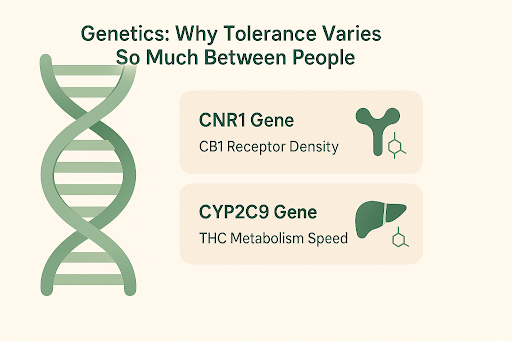
- The CNR1 Gene: This gene codes for the CB1 receptor itself. Variations here can affect the baseline density and efficiency of your receptors. If your genetic makeup naturally results in fewer or less responsive CB1 receptors, you may have a high natural tolerance, leading you to wonder why do some people have a higher tolerance to marijuana than others right out of the gate.
- The CYP2C9 Gene: This gene dictates the speed of the CYP450 liver enzymes. A highly active variant means THC is metabolized quickly, leading to a shorter, less intense subjective experience—a form of natural drug insensitivity.
This explains why some people are “high responders” who “get high easily,” while others are “low responders” who barely feel anything, often struggling with cannabis desensitization early on.
The Endocannabinoid System Blueprint
Your entire ECS is genetically unique, determining not just CB1 receptor quantity but also the production and breakdown of your own natural endocannabinoids (like anandamide). This makes endocannabinoid system adaptation a highly personalized phenomenon.
Other Factors That Shape Weed Tolerance
Tolerance is a holistic picture, not just a single gene or a single receptor. Numerous weed tolerance factors contribute to the speed of weed tolerance buildup:
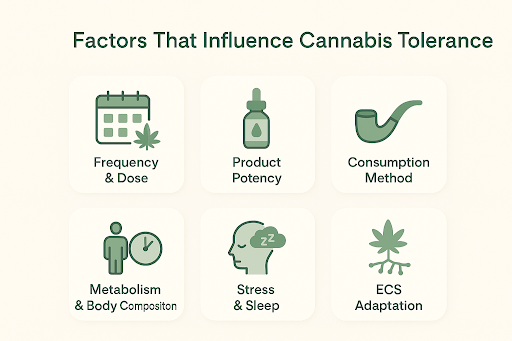
- Frequency and Dose: The most obvious factor is the principle of pharmacodynamic tolerance. The more often you use and the higher the dose, the faster the downregulation occurs.
- Product Potency: Highly concentrated products (vapes, dabs) flood the system with massive amounts of THC, accelerating cannabis receptor desensitization far quicker than traditional flower.
- Consumption Method: Edibles, which are metabolized into a different, more potent compound (11-hydroxy-THC), have a distinct tolerance profile compared to smoking or vaping.
- Metabolism & Body Composition: THC is fat-soluble. Your ratio of body fat to lean muscle, along with your overall metabolism, influences how THC is stored, metabolized, and released over time.
- Stress, Sleep, and Diet: The ECS is inextricably linked to cortisol (stress), inflammation, and the gut microbiome. High stress or poor sleep drains your internal resources, reducing your overall resilience and making you more prone to seeking relief through cannabis, thereby accelerating tolerance.
High Tolerance vs Low Sensitivity (Two Different Things)
Some people ask why do some people need more THC and assume it’s just tolerance.
Not true.
There’s a big difference between:
- High tolerance — caused by repeated THC exposure
- Low sensitivity — caused by genetics or low receptor density
This explains why more THC does not always get you higher.
If someone’s receptors are less responsive, piling on potency won’t fix that.
Your biology isn’t broken — it’s simply built differently.
9. FAQ Section
1. Why do some people need more weed to feel the effects?
Genetics, receptor density, metabolism, and tolerance levels all influence how strongly THC hits. Some people naturally break down THC faster or have fewer CB1 receptors, making the high feel weaker.
2. How does weed tolerance develop?
Tolerance builds as CB1 receptors become less sensitive to THC due to repeated exposure. The brain reduces receptor activity to maintain balance.
3. Can you build a tolerance to cannabis?
Yes. Regular use almost always leads to tolerance as your receptors adapt. This can happen within a few weeks.
4. Why do some people have a higher tolerance to marijuana?
Genetics, heavy use history, and metabolic speed all contribute to higher tolerance. Some people also develop tolerance faster than others.
5. How long does it take to build weed tolerance?
Typically 2–4 weeks of daily or frequent use. Some people develop tolerance even faster depending on genetics.
6. How can you reset your cannabis tolerance?
A tolerance break of 3–21 days allows receptors to resensitize. Sleep, hydration, and anti-inflammatory nutrition help accelerate the reset.
7. What causes cannabis tolerance on a biological level?
Receptor downregulation and desensitization are the primary causes. The brain reduces its response to THC over time.
8. Does genetics affect weed tolerance?
Yes. Genes controlling receptor structure and metabolism determine how strongly you feel THC.
9. Why do some people not get high from marijuana?
Low CB1 receptor density, rapid metabolism, or genetic variations can blunt the effects of THC, especially for beginners.
10. What are the signs of cannabis tolerance?
Needing more THC, shorter highs, weaker effects, and switching strains frequently.
11. Is cannabis tolerance reversible?
Yes. Receptors recover when THC exposure decreases.
12. How does repeated cannabis use affect tolerance?
It makes receptors less responsive, reducing the intensity and duration of the high.
13. Why does tolerance increase with regular cannabis use?
The endocannabinoid system adapts to consistent THC exposure by turning down receptor sensitivity.
14. How to reduce or manage weed tolerance?
Use tolerance breaks, vary consumption methods, and support your ECS with sleep, nutrition, and stress management.
Final Thoughts
The single biggest takeaway from weed tolerance science is this: your relationship with cannabis is deeply personal, rooted in biology, genetics, and habits.
You’re not “broken” if you need more. You’re not “weak” if you need a break. You are simply human, and your endocannabinoid system is doing its job by trying to keep your body stable. The confusion ends when you replace judgment with curiosity.
If you want a clearer, more intentional relationship with cannabis—one rooted in self-awareness instead of autopilot—the Grounded app gives you the structure, tracking, and support to get there. It’s the tool you need to plan your T-breaks, manage cravings, and monitor your unique weed tolerance factors.
You don’t have to guess how does weed tolerance develop over time anymore. You get to understand it—and own it.
0 Comments