
You’ve probably heard the line: “Cannabis is natural—so it must be safe.” But as medical cannabis becomes mainstream, a more complicated picture is emerging. Behind the growing list of therapeutic wins—pain relief, anxiety control, better sleep—there’s a quieter question rising among researchers: What are the long-term psychiatric effects of medical cannabis use?
Recent research suggests that long-term medical cannabis use and psychiatric side effects may be more connected than we think. And while most people focus on the physical outcomes—like tolerance or dependence—the real impact might be happening silently, in the mind.
We’re diving deep into the psychiatric risks of prolonged medical cannabis use—what’s fact, what’s still unclear, and how to use cannabis responsibly if it’s part of your wellness journey.
The Overlooked Shadow of Long-Term Use
Medical cannabis was once framed as a safer, natural alternative to opioids. And for many patients, it truly helps. But just as with any long-term medication, benefits can come with trade-offs.
- Cannabis and Psychosis Risk
Let’s start with one of the most researched—and misunderstood—links: cannabis psychosis.
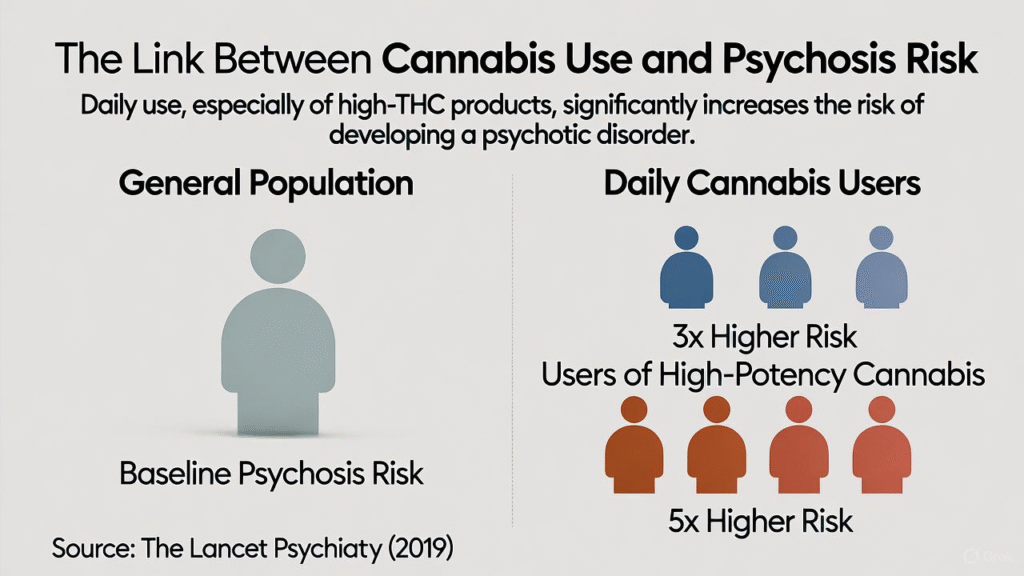
A 2019 Lancet Psychiatry study following over 2,000 participants across Europe found that daily cannabis users were three times more likely to develop a psychotic disorder, and that risk jumped to five times higher for users of high-potency strains (>10% THC).
Psychosis here doesn’t mean “instant insanity”—it’s often a temporary or chronic state involving paranoia, delusions, or hallucinations.
The key takeaway? Cannabis psychosis risk rises with sustained exposure to THC, especially among those with a family history of schizophrenia or other psychiatric disorders. Researchers at Harvard Medical School point out that these cases are likely not random—cannabis-induced psychosis from long-term use often occurs in people with genetic or neurobiological predispositions.
So, does that mean cannabis causes schizophrenia? Not exactly. The consensus so far: it can unmask or accelerate underlying vulnerabilities.
- Anxiety, Depression, and Dependence
You’ll often hear people say cannabis helps them “calm down.” And for many, that’s true—short-term relief is one reason so many turns to it for anxiety or sleep. But prolonged use tells another story.
A growing body of research suggests that heavy users are more likely to experience mood fluctuations, emotional flatness, and even withdrawal-linked anxiety. A Frontiers in Psychiatry review in 2022 found that while low doses of THC can reduce anxiety, chronic medical cannabis use and risk of depression and anxiety tend to rise with consistent, long-term exposure.
Ever feel that slow fade of ambition, where things you once loved just… don’t spark the same joy? That’s not just you being lazy. It’s your brain’s reward system quietly adapting. Researchers call it “amotivational syndrome”—that creeping disinterest in goals or pleasure that can shadow long-term use.

But it goes deeper than just low motivation. This rewiring is at the heart of cannabis use disorder (CUD)—a real, clinical diagnosis recognized by the DSM-5. Think it’s rare? Stats tell a different story: while about 1 in 10 users develop it, for those who start young or use daily, the odds jump to nearly 1 in 6.
The signs are more than just a habit; they’re a pattern:
- Chasing the same relief: Needing more to get the same effect.
- The struggle to stop: Irritability, sleep disruption, or anxiety when you try to take a break.
- Using despite the cost: Continuing even when it’s clearly hurting your mental or physical well-being.
So, how do you spot these shifts before they spiral? This is where Grounded turns guesswork into clarity. By tracking your moods, sleep quality, and usage patterns, you get a real-time dashboard of your mind. It’s accountability, backed by data—helping you catch the subtle changes that signal it’s time to pull back.
- Cognitive Decline and Emotional Regulation
Another area of concern? The long-term cognitive effects of medical cannabis in adults.
According to a study from the University of Montreal, adults who used cannabis heavily for over five years showed measurable declines in memory, attention, and processing speed. These findings align with NIH-funded work that found long-term effects of THC on the hippocampus—the brain’s memory hub—leading to reduced gray matter volume in chronic users.
This doesn’t mean every user experience cognitive decline, but rather that chronic cannabis cognitive effects can accumulate subtly—like background noise you stop noticing until it’s gone.
And here’s where things overlap with mood regulation: these same regions of the brain also manage motivation and stress response, so what starts as “mild forgetfulness” can cascade into mood dips and irritability.
- Cannabis Withdrawal and Psychiatric Symptoms
If you’ve ever tried taking a tolerance break after steady cannabis use, you might know this phase well.
The cannabis withdrawal psychiatric symptoms—restlessness, irritability, sleep disruption, low mood—aren’t just uncomfortable; they’re proof that long-term THC exposure recalibrates emotional stability.
According to the National Institute on Drug Abuse, withdrawal tends to last 7–14 days, peaking around day 3 or 4, and can include mood swings, anxiety, vivid dreams, and appetite changes. These symptoms mirror those seen in mild depressive or anxiety disorders.
This is where the Grounded app becomes useful: by logging withdrawal patterns and daily mood shifts, you get measurable feedback that helps differentiate between normal adjustment and deeper psychiatric effects that may need professional attention.
- Cannabis Use Disorder: A Hidden Mental Health Concern
Dependence doesn’t always look like addiction. It can show up as irritability, insomnia, or anxiety when skipping doses—a sign of cannabis withdrawal psychiatric symptoms.
There is a significant chance that a cannabis user will develop cannabis use disorder, and the risk doubles for those who start young or use daily.
Common cannabis use disorder symptoms include:
- Needing more THC for the same relief
- Struggling to cut back
- Using despite emotional or social fallout
This doesn’t mean medical users are doomed to addiction. But without structured check-ins or dose monitoring, cannabis dependence and psychiatric symptoms after long-term use can slip in quietly.
High-Potency THC: A Modern Variable
Not all cannabis is created equal. The long-term effects of THC on mental health depend greatly on potency—and that’s where modern cannabis changes the game.
In the 1990s, average THC content was under 5%. Today, concentrates and vapes often exceed 70–90% THC, creating an entirely new exposure profile.
Using weed with high levels of THC can raise cannabis psychosis risk, worsen problems with thinking and memory, and add to the mental health issues linked with cannabis addiction. This applies even to people using THC for medical reasons like pain or trouble sleeping – they can quickly become tolerant and need higher amounts, which often makes mental health side effects worse.
This really highlights an important point: how medical cannabis affects someone over the long term can change a lot based on the type of product, how much is used, and how it’s taken. Something that might be helpful in small, occasional doses could actually become unbalancing if used every day in large amounts.
Who’s Most at Risk? It’s Not One-Size-Fits-All
Your friend might be fine, so why are you feeling off? Vulnerability isn’t random. Key risk factors turn up the volume on potential side effects.
- Your Genetic Blueprint: A personal or family history of psychosis or mood disorders is the single biggest red flag.
- The Potency Problem: This is critical. The question of how do high-potency THC products affect mental health risks has a clear answer: they amplify them. Concentrates and potent edibles are a different beast compared to the flower of decades past.
- Age of First Use: The adolescent brain is under construction; introducing high-THC cannabis can fundamentally alter its wiring.
Understanding who is more susceptible to psychiatric effects from cannabis helps shape safer, more personalized approaches—something that’s core to mindful consumption.
Balancing Therapeutic Benefits and Psychiatric Risks
Now, here’s the nuance that often gets lost in polarized debates: medical cannabis is not inherently harmful—but context, dose, and intention matter.
When used thoughtfully, under guidance, and tracked carefully, cannabis can relieve symptoms of chronic pain, PTSD, and insomnia without major side effects. But unchecked, especially in high-THC forms, it can cross the line from helper to harm.
This is why many clinicians now emphasize long-term medical cannabis use documentation—consistent tracking of symptoms, doses, and mental health trends. Apps like Grounded help bridge this gap, offering users real-time insights into how cannabis affects their mood and focus.
FAQs:
Q. What are the psychiatric side effects of long-term medical cannabis use?
Mood swings, anxiety, depression, reduced motivation, and psychosis in high-risk individuals.
Q. Can long-term cannabis use cause anxiety and depression?
Yes. Chronic THC exposure alters serotonin and stress-response pathways, increasing vulnerability.
Q. Is there a risk of psychosis or schizophrenia from medical cannabis?
Research shows long-term users face higher psychosis risk—especially with strong THC and genetic predisposition.
Q. How does long-term cannabis use affect mental health?
It can disrupt dopamine signaling, slow cognitive processing, and heighten stress response.
Q. Can medical cannabis lead to dependence or addiction?
Yes. Prolonged use can lead to cannabis use disorder—marked by tolerance, craving, and emotional dysregulation.
Q. What are the signs of cannabis withdrawal related to psychiatric symptoms?
Irritability, low mood, vivid dreams, restlessness, or sleep trouble lasting up to two weeks.
Q. Are some people more susceptible to psychiatric effects from cannabis?
Yes—especially adolescents, individuals with mood disorders, or those using high-potency products.
Q. How do high-potency THC products affect mental health risks?
Potent THC increases dopamine dysregulation and can trigger cannabis-induced psychosis in vulnerable users.
References:
- https://www.thelancet.com/journals/lanpsy/article/PIIS2215-0366(19)30048-3/fulltext
- https://www.frontiersin.org/journals/psychiatry/articles/10.3389/fpsyt.2021.623403/full
- https://my.clevelandclinic.org/health/articles/4392-marijuana-cannabis
- https://www.samhsa.gov/substance-use/learn/marijuana/risks
- https://nida.nih.gov/research-topics/cannabis-marijuana#short-term-health-cannabis
- https://pmc.ncbi.nlm.nih.gov/articles/PMC6312155/
0 Comments