
You love relaxing at the end of a long week, but if you’re anything like me—or the millions of people rethinking their habits—you’re starting to wonder if that glass of wine or those few beers are doing more harm than good. The hangovers, the creeping anxiety the next morning, the poor sleep—are they really worth it?
This isn’t just about the sober curious trend. It’s part of a cultural and scientific shift. For the first time in history, daily cannabis use has outpaced alcohol consumption in the United States. Many people are making this change to reduce their exposure to substance abuse risks and the well-documented health risks of alcohol.
So, what does science tell us about this shift? While all intoxicating substances come with their own trade-offs, the evidence comparing cannabis vs alcohol effects reveals profound differences in lethality, long-term damage, and social cost. Let’s unpack what the experts say—so you can move beyond the stigma and make informed choices about your body and your wellness journey.
The Research Gap: Why Comparing Cannabis and Alcohol Isn’t Easy
Before getting into numbers, it’s crucial to understand one thing — we know a lot more about alcohol than cannabis.
According to Healthline, researchers have decades of long-term data on alcohol use, while cannabis research is only ramping up. This means cannabis may appear safer partly because we don’t yet have equally comprehensive studies.
Still, early data paints a consistent picture: while neither substance is risk-free, the public health impact of alcohol — in deaths, disease, and social harm — far exceeds that of cannabis.
Short-Term Effects: What Happens When You Consume Each
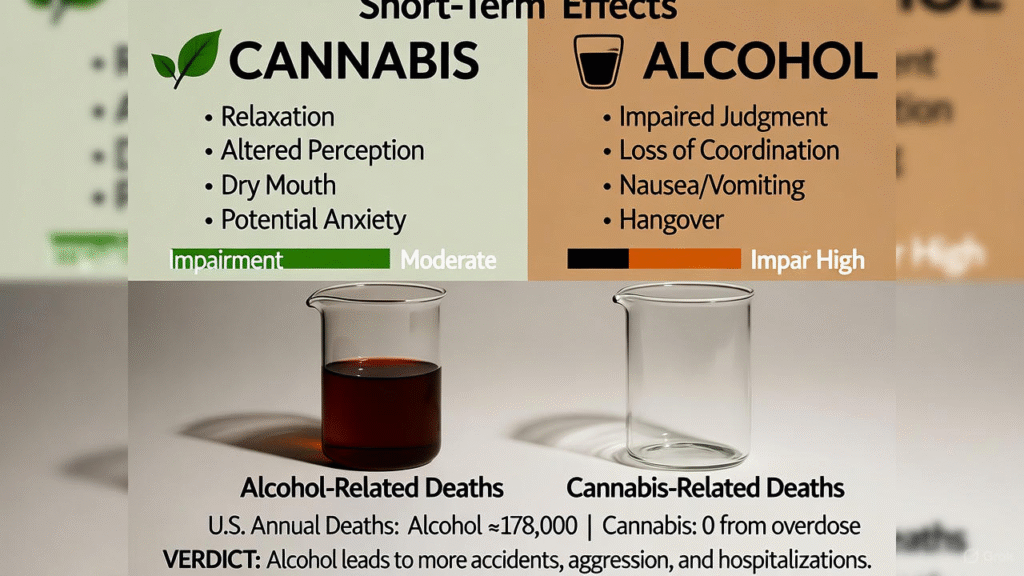
Alcohol
Alcohol depresses the central nervous system, impairing judgment, coordination, and reaction time. The CDC warns that even moderate drinking can affect motor skills, leading to accidents and injuries.
Other short-term effects include:
- Impaired decision-making
- Loss of coordination and reflexes
- Nausea and vomiting
- Hangovers, dehydration, and headaches
Business Insider notes that the next-day “crash” from alcohol — fatigue, mood drops, dehydration — tends to be harsher and more prolonged than cannabis’s lingering effects.
Cannabis
The effects of cannabis vary widely by strain, method of consumption, and user tolerance. Common short-term effects include:
- Relaxation and euphoria
- Altered perception of time and space
- Short-term memory challenges
- Coordination issues
- Dry mouth or red eyes
While most people report calm or mild euphoria, others experience anxiety or paranoia, especially with high THC levels. Harvard Health points out that overconsumption — particularly through edibles — can turn an otherwise mellow evening into an unpleasant experience.
Verdict:
Both impair cognition and reflexes, but alcohol tends to result in more accidents, aggression, and hospitalizations than cannabis, according to the World Health Organization (WHO).
Long-Term Health Risks: What Science Reveals
Alcohol’s Toll
Chronic alcohol intake has been linked to more than 200 diseases, including:
- Liver disease (cirrhosis, hepatitis)
- Heart damage and high blood pressure
- Pancreatitis
- Cancer (mouth, throat, liver, breast, and colon)
- Neurological decline
The CDC reports that alcohol contributes to about 178,000 deaths annually in the U.S. — including accidents and long-term illnesses.
Cannabis: Still Under Study
Research on cannabis’s long-term effects remains mixed. Studies such as ScienceDirect’s review of cannabis pharmacology suggest:
- Possible cognitive changes in adolescents who start using heavily before age 25
- A potential link to schizophrenia in genetically predisposed individuals
- Respiratory issues for people who smoke cannabis regularly
However, a 2006 UCLA study published in Cancer Epidemiology found no increased lung cancer risk even among heavy cannabis users — a sharp contrast with tobacco and alcohol-related cancers.
Verdict:
Science agrees that while cannabis can have cognitive and psychological risks, alcohol remains far more toxic, with exponentially higher mortality and disease burden.
Addiction and Misuse Potential
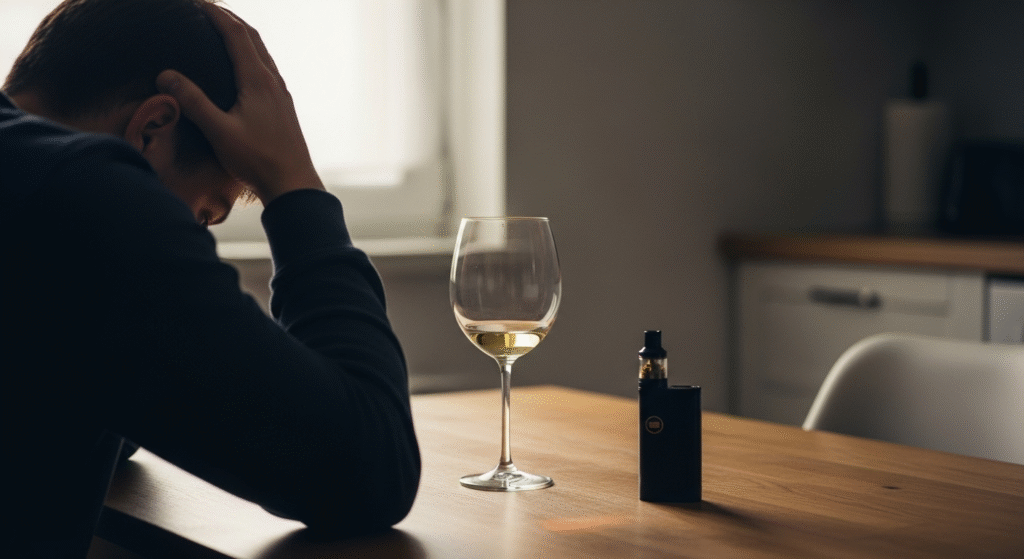
Both substances can lead to dependency, but not equally.
Alcohol
According to the NIAAA (National Institute on Alcohol Abuse and Alcoholism), nearly 29 million Americans aged 12 and up live with alcohol use disorder (AUD). Symptoms include cravings, withdrawal, and loss of control.
Cannabis
The Marijuana Policy Project cites multiple studies (including data from the Institute of Medicine) showing that only about 9% of cannabis users develop dependence — compared to 15% for alcohol users.
Moreover, cannabis withdrawal tends to be milder, often involving irritability and sleep issues rather than dangerous physical symptoms like seizures or delirium tremens seen in alcohol withdrawal.
Verdict:
Alcohol addiction is more widespread, more physically dangerous, and harder to treat than cannabis dependence.
Impact on Society: Violence, Accidents, and Public Health
Research consistently shows that alcohol contributes to violent behavior, domestic abuse, and crime, whereas cannabis does not.
A meta-analysis in Addictive Behaviors found that alcohol intoxication is strongly correlated with aggression, while cannabis often reduces it. The U.S. Department of Justice attributes roughly 25–30% of violent crimes to alcohol use; marijuana, by contrast, is rarely linked to aggression.
The Marijuana Policy Project highlights further that alcohol use costs the U.S. economy billions in healthcare, lost productivity, and accidents — while cannabis’s public health burden remains significantly smaller.
How Consumption Methods Change the Risk Equation
Drinking vs. Smoking vs. Edibles
Alcohol is typically consumed through beverages, which are quickly absorbed into the bloodstream. The faster you drink, the greater the intoxication risk.
Cannabis, however, comes in many forms: smoking, vaping, edibles, and drinks. According to Harvard Health Publishing, cannabis beverages are absorbed faster than edibles and can produce effects within 20 minutes — but dosing inconsistency is still a concern.
Smoking, on the other hand, introduces harmful toxins into the lungs. The CDC warns that any form of smoke — cannabis or tobacco — contains carcinogens. For those exploring safer consumption, vaporization or edibles may reduce respiratory harm.
Emerging Trends: “Cali Sober” and Shifting Norms
The “Cali sober” movement, as described by Harvard Health Publishing, reflects a growing shift — people giving up alcohol but occasionally using cannabis to unwind.
A 2024 CNN report found that daily cannabis use has now surpassed daily alcohol use in the U.S. for the first time, especially among adults seeking alternatives to hangovers and health risks.
Experts caution, though: cannabis isn’t risk-free. Overuse can cause anxiety, increased heart rate, and, for some, dependence. Moderation and education remain key.
Scientific Consensus: Which Is Riskier Overall?
- Alcohol causes far more deaths, disease, and social harm worldwide.
- Cannabis poses risks, especially for youth and heavy users, but has no recorded overdose deaths.
- Dependence rates and toxicity levels are much lower for cannabis.
- However, smoked cannabis carries respiratory risks similar to tobacco.
As the World Health Organization, CDC, and multiple peer-reviewed studies conclude, cannabis’s overall public health burden remains modest compared to alcohol.
FAQs
Q. Is cannabis safer than alcohol?
From the perspective of toxicity, fatal risk, and association with violence, yes, Cannabis is scientifically shown to be less dangerous than Alcohol. However, Cannabis carries unique risks, particularly related to adolescent brain development and psychosis risk in predisposed individuals.
Q. Can you overdose on cannabis?
No fatal overdoses have been documented, unlike alcohol poisoning, which kills thousands annually.
Q. Does cannabis cause cancer?
Current evidence (UCLA, 2006) shows no conclusive link between cannabis use and cancer, though smoking any substance can harm the lungs.
Q. Which is more addictive, alcohol or cannabis?
Alcohol. Roughly 15% of users develop dependence versus about 9% for cannabis users, according to the Institute of Medicine.
The Science Is Clear — But Your Choice Matters
When you weigh the science, the evidence leans one way: cannabis is less harmful overall than alcohol. But that doesn’t make it harmless.
Both substances affect your body and mind in powerful ways. The key is awareness, moderation, and mindfulness — understanding how each affects you personally.
If you’re exploring ways to use cannabis responsibly, track your habits, or find balance in your lifestyle, the Grounded app can help you do just that — helping you stay mindful, intentional, and in control of your wellness journey.
Your clarity starts today.
References
0 Comments